| |

Photo by L. Barrett-Lennard and K. Heise
Social Organization
Whales make their home wherever they happen to be in
their aquatic environment, unlike terrestrial mammals which live in a
den or nest.
The social bond binds families of whales together in the aquatic environment
they inhabit.
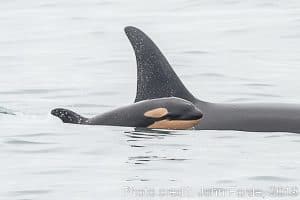
Killer whale pods are matriarchal, where females travel with their sons
and daughters throughout their lives. These family units in the resident
community are known as MATRILINES.
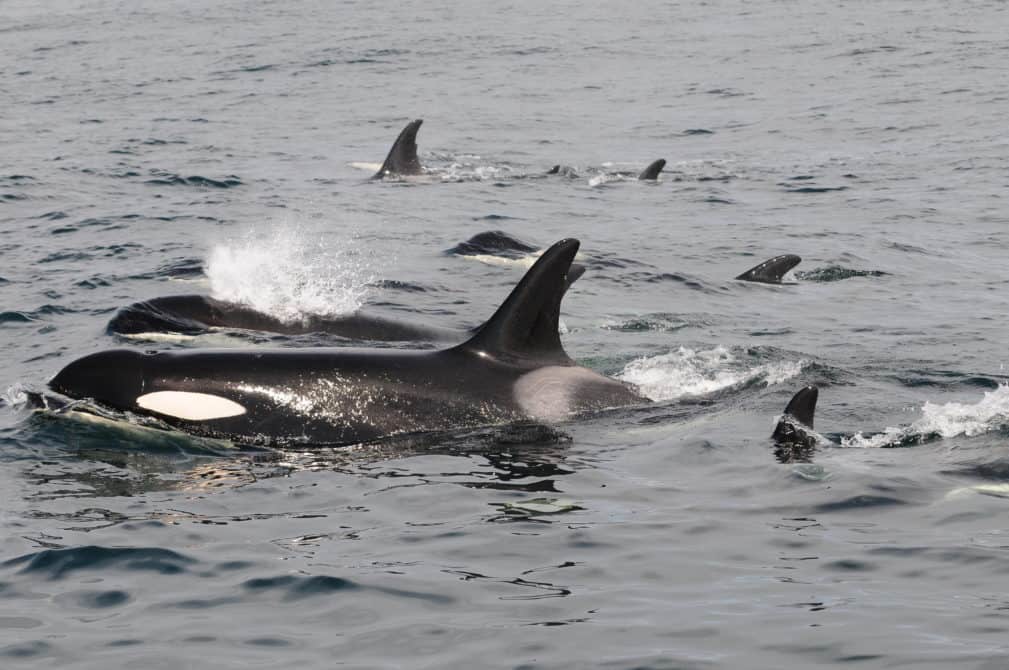
A pod is a larger unit that is made up of one or more matrilines that
travel together.
These bonds remain strong between siblings even after the mother has died.
Transient killer whales do not have as structured a social system as residents
and individuals may leave their mother to travel alone or with other whales.

click on either "A clan" or "R clan" for examples.
Genetics
How do resident killer whales avoid inbreeding if sons
and daughters stay with their mother all their life? Dr. Lance Barrett-Lennard,
senior marine mammal scientist at the Vancouver Aquarium Marine Science
Centre, recently completed a long-term study that helped to answer this
and other questions that have long eluded killer whale researchers. By
analyzing DNA from tiny skin samples taken from more than 300 killer whales
in B.C. and Alaska, Dr. Barrett-Lennard could do two things: determine
paternities (who the fathers are) and how communities of killer whales
are related to one another. He found out what had long been suspected.
- Paternity tests showed that matings never occur within
matrilines, very rarely occur within pods and overwhelmingly occur outside
clans.
- There is a clear link between the calls that killer
whales make and who they mate with. The more similar the dialects of
two groups, the more related they are. Killer whales tend to mate with
partners that don't sound like themselves.
- Transient and resident killer whales represent distinct
lineages with little or no exchange of individuals or interbreeding.
The differences are so great that they have likely been isolated genetically
for many thousands of years.
- Northern and southern resident killer whales are more
closely related but haven't interbred for at least hundreds of generations.
- Researchers are also able to use DNA to determine
whether a killer whale is a male or female.
|
Genealogy Studies of killer whales
along the coasts of Washington and British Columbia have been taking place
for approximately 30 years. Due to the long duration of these studies
every resident killer whale along the British Columbia and Washington
coast has been photographed and identified as belonging to a specific
matriline.
| Community:
comprises all pods that travel together; pods from different communities
have never been seen together. |
Clan:
one or more pods that share a related dialect; pods within a clan
have probably descended from a common ancestral group and therefore
are probably more closely related to each other than to pods from
other clans.
|
Pods:
one or more matrilines that usually travel together; term relevant
only to resident whales.
|
| Matrilines:
the basic social unit of resident killer whales, composed of
a mature female and her immediate descendants; descendants may include
mature males and mature daughters and their offspring. |

DNA analysis gel.
Each row is a "microsatellite" DNA from a different individual,
except for the multi-band rows at the edges that contain reference DNA
Want the latest information on B.C.'s killer
whales?
Both books include ID catalogue.
"Killer Whales-2nd edition" $22.95,
"Transients" $24.95.
To order call 1-800-663-0562 or e-mail clamshell@vanaqua.org
|